
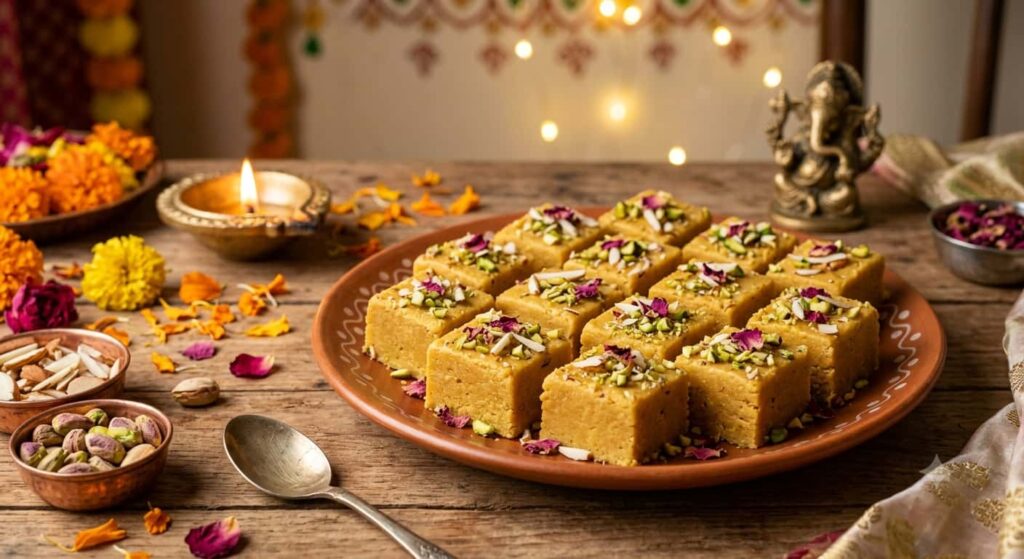
If there’s one sweet that instantly reminds me of Diwali, it’s besan burfi. The smell of ghee and roasted gram flour floating through the kitchen, the sound of the ladle scraping the pan, and that first bite of a soft, melt-in-mouth square -it just feels like festival season.
The good news? You don’t need to be an expert halwai to make it at home. This besan burfi recipe uses simple pantry ingredients, needs no candy thermometer, and comes together in under 40 minutes. Whether you’re making it for Diwali, Raksha Bandhan, or just a random Tuesday sweet craving, this recipe will give you soft, grainy-yet-smooth burfi every single time.
Let’s get into it.
What is Besan Burfi?
Table of Contents
Besan burfi (also called besan barfi, besan ki barfi, or besan chakki) is a classic North Indian sweet made from three simple ingredients -gram flour (besan), ghee, and sugar. The besan is slow-roasted in ghee until it turns golden and fragrant, then mixed with a sugar syrup and set into a tray. Once cooled, it’s cut into diamond or square pieces.
It’s one of the easiest Diwali sweet recipes to make at home because it doesn’t need any fancy equipment, doesn’t involve deep frying, and stores well for days -perfect for gifting in mithai boxes too.
Why This Recipe Works
Most besan barfi recipes fail for one of two reasons -either the besan isn’t roasted properly (leaving a raw, bitter aftertaste) or the sugar syrup consistency is off (leaving the burfi too hard or too soft to set). This recipe fixes both problems by:
- Giving you the exact roasting time and visual cues to look for
- Explaining the one-string sugar syrup consistency in simple, no-thermometer terms
- Using a ratio of besan, ghee, and sugar that’s been tested to set perfectly at room temperature
Ingredients for Besan Burfi
Here’s everything you’ll need. This makes roughly 20-24 medium-sized pieces.
| Ingredient | Quantity |
| Besan (gram flour) | 2 cups (about 200g) |
| Ghee | 3/4 cup (180g), divided |
| Sugar | 1 cup (200g) |
| Water | 1/2 cup |
| Milk (optional, for softer texture) | 2 tbsp |
| Cardamom powder | 1/2 tsp |
| Chopped nuts (almonds, pistachios) | 2-3 tbsp |
| Saffron strands (optional) | a pinch |
A quick note on besan: Use fine, good-quality gram flour for a smooth burfi. If you only have the slightly coarse variety, sift it once before using -it makes a real difference to the final texture.
How to Make Besan Burfi (Step-by-Step)
Step 1: Prep Your Tray
Grease a 7×7 inch or 8×8 inch tray with a little ghee, or line it with parchment paper. Keep it ready before you start cooking -once the burfi mixture is ready, you’ll need to pour it in quickly.
Step 2: Roast the Besan
Heat 1/2 cup of ghee in a heavy-bottomed pan or kadhai on low-medium heat. Once it melts, add the besan and mix well so there are no lumps.
Now comes the most important part -roasting. Keep the heat on low and stir continuously for 12-15 minutes. The besan will go through a few stages:
- First it will look dry and grainy
- Then it will start clumping together
- Finally, it will loosen up, turn a light golden colour, and release a distinctly nutty, roasted aroma
This last stage is what you’re looking for. If you stop roasting too early, your burfi will taste raw and slightly bitter. If you go too far, it will taste burnt. Trust the aroma more than the clock -every stove and pan heats a little differently.
Once roasted, add the remaining 1/4 cup ghee, mix well, and turn off the heat. Set this mixture aside.
Step 3: Make the Sugar Syrup
In a separate pan, add sugar and water. Heat on medium flame and stir until the sugar dissolves completely. Let it simmer for 4-5 minutes without stirring too much.
To check if it’s ready, take a drop of syrup between your thumb and forefinger and gently pull them apart. If you see a single thin string forming, your syrup is at the right “one-string consistency.” This is the stage where the burfi will set well without becoming too hard or too soft.
If you don’t trust the string test yet, here’s an easier way: the syrup is ready when it becomes slightly sticky and a drop of it, placed on a plate, doesn’t spread out immediately.
Add the cardamom powder and saffron (if using) to the syrup and mix.
Step 4: Combine and Set
Turn the heat to low, and add the roasted besan mixture to the sugar syrup. Stir quickly and continuously -the mixture will thicken fast at this stage. If you’re adding milk for a softer, richer texture, add it now and mix well.
Cook for just 1-2 minutes on low heat, stirring constantly, until everything comes together into a thick, glossy mixture.
Step 5: Pour, Garnish, and Cut
Immediately pour the mixture into your greased tray. Spread it evenly using the back of a spoon or a spatula. Sprinkle the chopped nuts on top and press them down gently so they stick.
Let it cool at room temperature for 2-3 hours. Once it’s firm but not rock-hard, cut it into square or diamond pieces using a sharp knife. Let it set completely for another hour before removing the pieces from the tray.
Cooking Time and Yield
- Prep time: 10 minutes
- Cook time: 25 minutes
- Setting time: 3 hours
- Total time: Around 3 hours 35 minutes (mostly hands-off)
- Yield: 20-24 pieces
Common Mistakes to Avoid
Since besan barfi looks simple but depends heavily on technique, here are the mistakes that trip up most beginners:
- Under-roasting the besan: This is the number one reason burfi tastes raw. Don’t rush this step, even if it feels like it’s taking too long.
- High flame while roasting: Besan burns quickly and unevenly on high heat. Always roast on low to medium-low.
- Wrong sugar syrup consistency: A runny syrup won’t let the burfi set, while an overcooked one will make it hard and sugary instead of smooth.
- Not greasing the tray properly: The burfi can stick to the tray if it isn’t greased or lined well, making it hard to cut clean pieces.
- Cutting too early or too late: Cut when it’s just firm -waiting till it’s fully hardened will make cutting clean pieces difficult.
Tips for Perfect Besan Burfi Every Time
- Always use a heavy-bottomed pan. A thin pan heats unevenly and increases the chances of burning the besan.
- Keep all your ingredients measured and ready before you start -this recipe moves fast once the syrup is ready.
- If your burfi turns out slightly soft, refrigerate it for an hour before cutting. This firms it up without changing the taste.
- Adding 2 tablespoons of milk powder along with the roasted besan gives the burfi a richer, more mithai-shop-like texture.
- For a shinier top, brush a thin layer of warm ghee over the surface before it sets completely.
Variations of Besan Burfi
One of the best things about this gram flour sweet is how easily it can be customised:
- Besan Burfi with Milk Powder: Add 2-3 tablespoons of milk powder while mixing the roasted besan into the syrup for a richer, fudgier bite.
- Besan Burfi with Rava: Some halwai-style recipes add 2 tablespoons of fine semolina along with the besan while roasting. It gives the burfi a slightly chewy, moist texture.
- Dry Fruit Besan Burfi: Mix in finely chopped cashews, almonds, and raisins into the roasted besan mixture itself, not just as a garnish.
- Sugar-Free Version: Replace sugar with a jaggery-based syrup for a more traditional, less refined-sugar option. Note that the colour and flavour will be noticeably different.
- Vegan Besan Burfi: Swap ghee with a neutral vegetable oil or vegan butter. The taste will differ slightly, but it still sets well.
How to Store Besan Burfi
Besan burfi stores really well, which is part of why it’s such a popular festival sweet.
- At room temperature: Store in an airtight container for up to 5-6 days, especially in cooler weather.
- In the refrigerator: Keeps well for up to 2-3 weeks. Let it come to room temperature before serving for the best texture.
- Freezing: You can freeze besan burfi for up to a month. Thaw it in the refrigerator overnight, then bring it to room temperature before eating.
Always store it in a single layer or separate layers with parchment paper so the pieces don’t stick together.
Serving Suggestions
Besan burfi is traditionally served as part of a Diwali mithai platter alongside other sweets like kaju katli or besan ladoo. It also works well:
- As an after-meal sweet with a cup of masala chai
- Packed into gift boxes for festivals and celebrations
- As a quick energy bite, since gram flour is a good source of protein and fibre
- Served slightly warm with a scoop of vanilla ice cream for a fun fusion dessert
Frequently Asked Questions
This usually happens when the sugar syrup hasn’t reached the right consistency. If the syrup is undercooked, the mixture stays soft even after hours of cooling. You can fix this by returning the mixture to the pan, cooking it for another 2-3 minutes on low heat, and then setting it again.
This means the besan wasn’t roasted long enough. Raw besan has a distinct raw, slightly bitter taste and a pasty texture. Always roast until it turns light golden and smells nutty, not just warm.
Yes, some simpler versions mix powdered sugar directly into the roasted besan (similar to besan ladoo mixture) and press it into a tray. It won’t have the same fudgy texture as the syrup version, but it’s a quicker option.
Yes, besan (gram flour) is naturally gluten-free, making this a safe sweet for people avoiding gluten, as long as you don’t add semolina (rava) in any variation.
At room temperature, it stays fresh for about 5-6 days in an airtight container. Refrigerated, it can last up to 2-3 weeks.
You can, but ghee gives besan burfi its signature aroma and rich flavour. If you must substitute, use a neutral-tasting oil, though the taste will be noticeably different
Both use similar ingredients, but besan ladoo is rolled into round balls using powdered sugar, while besan burfi uses a sugar syrup and is set into a tray before being cut into pieces.
Final Thoughts
This besan burfi recipe proves that some of the best festival sweets don’t need long ingredient lists or complicated techniques -just a little patience while roasting the besan and getting the sugar syrup right. Once you’ve made it a couple of times, you’ll get a feel for the exact colour, smell, and texture to look for, and it becomes one of those recipes you can make from memory.
Give it a try this Diwali, and don’t be surprised if it becomes a permanent fixture on your festival sweet tray.
If you try this recipe, do let us know in the comments how it turned out, and check out more Diwali sweet recipes on Sawad India Ka for your festival spread.

Meena Devi is a home cook and recipe creator who has been cooking and sharing traditional Indian recipes since 2005. With years of hands-on experience in the kitchen, she loves turning everyday ingredients into simple, flavorful dishes that anyone can make at home.
Her recipes are based on tried-and-tested cooking methods, family favorites, and the everyday food she has prepared over the years. Through Sawad India Ka, Meena shares practical recipes, helpful cooking tips, and the flavors she grew up with.