
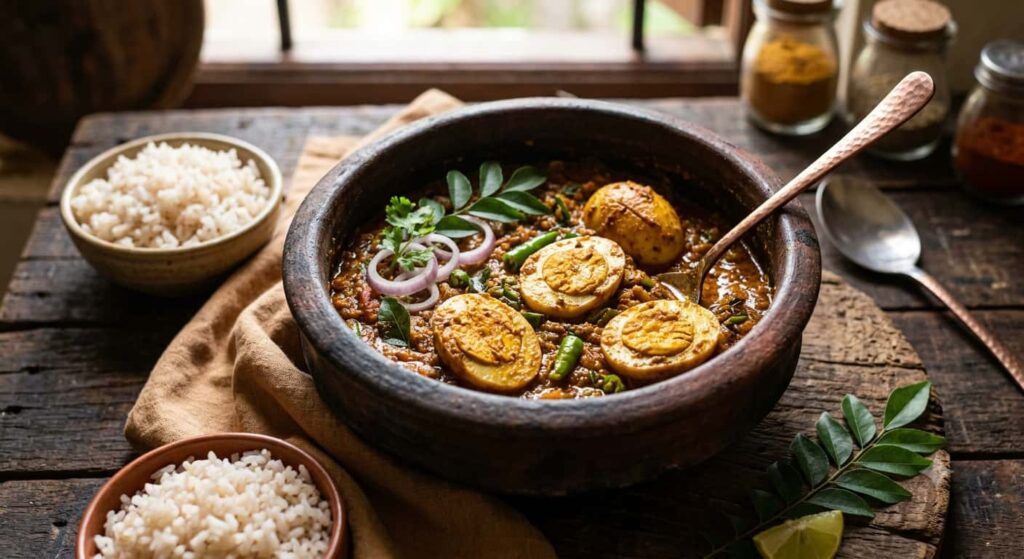
If you’ve ever eaten appam and egg curry at a Kerala breakfast joint, you already know why this dish has such a fan following. Kerala egg curry, known locally as Nadan Mutta Curry, is one of those recipes that looks simple on paper but tastes like someone’s grandmother has been perfecting it for decades. Boiled eggs sit in a deep red, coconut milk-based gravy loaded with curry leaves, black pepper, and slow-cooked onions -and somehow every spoonful tastes better than the last.
This is a from-scratch, no-shortcuts version of the classic Kerala style egg masala curry. I’ve tested it enough times to iron out the usual problems people run into -split coconut milk, rubbery eggs, bland masala -so you can get it right on the first try, even if you’ve never cooked Kerala food before.
Let’s get into it.
What Is Nadan Mutta Curry?
Table of Contents
“Nadan” simply means local or traditional in Malayalam, and “mutta” means egg. So Nadan Mutta Curry translates to “traditional local egg curry” -a dish you’ll find in almost every Kerala home and toddy shop, usually served alongside appam, puttu, or parotta.
What sets it apart from North Indian egg curries is the base. There’s no cream, no cashew paste, no heavy tomato gravy here. Instead, the flavour comes from coconut oil, curry leaves, freshly ground spices, and coconut milk added right at the end. The result is a gravy that’s spicy, slightly tangy, and rich without feeling heavy.
You’ll also come across a dry version of this dish called Mutta Roast or Egg Roast, where the gravy is cooked down until it clings to the eggs instead of pooling in the pan. I’ve covered that variation further down if you want to try it too.
Why This Recipe Works
- It uses whole, freshly ground spices along with powders, so the masala has real depth instead of tasting flat.
- The coconut milk goes in at the very end and never comes to a hard boil, so it stays smooth instead of splitting.
- The eggs are added just before serving, not simmered for ages, so they stay tender instead of turning rubbery.
- It’s genuinely an easy egg curry recipe -one pan, everyday ingredients, and about 35 minutes from start to finish.
Kerala Egg Curry -Recipe Overview
| Cuisine | Kerala, South Indian |
| Course | Main course / breakfast side |
| Prep time | 10 minutes |
| Cook time | 25 minutes |
| Total time | 35 minutes |
| Servings | 4 people |
| Difficulty | Beginner-friendly |
Ingredients for Kerala Egg Curry
For boiling the eggs
- 6 large eggs
For the masala paste
- 1 tablespoon coriander powder
- 1 teaspoon Kashmiri red chilli powder (for colour)
- ½ teaspoon regular red chilli powder (adjust to taste)
- ¼ teaspoon turmeric powder
- ½ teaspoon black pepper powder, freshly crushed
- 2 tablespoons water (to make a paste)
For the tempering and gravy
- 3 tablespoons coconut oil
- ½ teaspoon mustard seeds
- ¼ teaspoon fenugreek (methi) seeds
- 1 sprig curry leaves (about 15–18 leaves), plus a few extra for garnish
- 1 medium onion, thinly sliced
- 2 green chillies, slit lengthwise
- 1 tablespoon ginger, finely chopped or crushed
- 1 tablespoon garlic, finely chopped or crushed
- 2 medium tomatoes, finely chopped
- 1 cup water (adjust for consistency)
- ½ cup thin coconut milk (second extract, or diluted canned coconut milk)
- ¼ cup thick coconut milk (first extract, or undiluted canned coconut milk)
- Salt, to taste
Tip: If you only have canned coconut milk, use it undiluted for the “thick” portion and mix it with a little water for the “thin” portion.
How to Make Kerala Egg Curry (Step-by-Step)
Step 1: Boil the eggs correctly
Place the eggs in a saucepan and cover with cold water by about an inch. Bring to a boil, then lower the heat and let them simmer gently for 10–11 minutes. Immediately transfer the eggs to a bowl of cold water and let them sit for 5 minutes before peeling. This stops the cooking process and keeps the yolks from turning that grey-green colour around the edges.
Once peeled, make 2–3 shallow slits on each egg with a knife. This isn’t just for looks -it lets the eggs actually soak up the gravy instead of sitting there tasting plain.
Step 2: Make the masala paste
In a small bowl, mix the coriander powder, both chilli powders, turmeric, and black pepper powder with 2 tablespoons of water to form a smooth, thick paste. Making a paste instead of adding dry powders directly to the pan stops the spices from burning and turning bitter.
Step 3: Temper the spices
Heat coconut oil in a heavy-bottomed pan or kadai over medium heat. Once hot, add the mustard seeds and let them splutter. Add the fenugreek seeds and curry leaves right after -they’ll crackle within a few seconds, so keep the pan moving.
Step 4: Cook the onions
Add the sliced onions and a pinch of salt. Cook on medium-low heat for 8–10 minutes, stirring now and then, until the onions turn a deep golden brown. Don’t rush this step -this is where most of the curry’s flavour actually comes from. Add the green chillies, ginger, and garlic, and sauté for another minute until the raw smell disappears.
Step 5: Add the masala paste
Lower the heat slightly and add the masala paste you prepared earlier. Cook it for 2–3 minutes, stirring often, until the oil starts to separate at the edges of the pan. This step matters -if you skip it, the curry will taste raw and dusty no matter how good your ingredients are.
Step 6: Add tomatoes
Add the chopped tomatoes and cook until they turn soft and mushy, about 4–5 minutes. Mash them lightly with the back of your spoon as they cook.
Step 7: Build the gravy
Pour in the thin coconut milk (or diluted coconut milk) along with 1 cup of water. Add salt to taste. Bring the curry to a gentle simmer and let it cook uncovered for 6–8 minutes so the flavours come together and the raw coconut smell cooks off.
Step 8: Add the eggs
Slide the peeled, slit eggs into the gravy. Spoon some curry over the top so they’re coated. Cover and let them simmer on low heat for 4–5 minutes.
Step 9: Finish with thick coconut milk
Turn the heat down to its lowest setting and stir in the thick coconut milk. Let it warm through for a minute or two -do not let it come to a rolling boil, or it may split. Switch off the heat, scatter a few fresh curry leaves on top, and let the curry rest for 5 minutes before serving.
What to Serve with Kerala Egg Curry
This curry is genuinely flexible when it comes to pairing:
- Appam – the classic combination, especially for breakfast or dinner
- Kerala parotta – for a heartier, more filling meal
- Puttu – steamed rice cake, another traditional Kerala pairing
- Steamed rice – simple, everyday, and just as satisfying
- Dosa or idiyappam (string hoppers) – also work well if you want variety
Common Mistakes to Avoid
Boiling the curry after adding thick coconut milk. This is the number one reason coconut milk curries split. Once the thick milk goes in, keep the flame low and never let it bubble hard.
Skipping the masala paste step. Throwing dry spice powders straight into hot oil often burns them within seconds, giving the curry a bitter, gritty taste. A wet paste cooks more evenly.
Undercooking the onions. Pale, half-cooked onions leave the gravy tasting thin and raw. Golden brown onions are non-negotiable for a good nadan-style curry.
Overcooking the eggs in the gravy. Simmering eggs in curry for too long makes them rubbery and can turn the yolks that unappetising grey shade. Add them last, and give them just enough time to absorb flavour.
Using low-quality or refined oil instead of coconut oil. Coconut oil isn’t just a substitute here -it’s part of the flavour identity of this dish. If you genuinely can’t use it, any neutral oil will work, but the taste won’t be quite the same.
Variations You Can Try
Egg curry without coconut milk: Skip the coconut milk entirely and use extra water along with a splash of tamarind or a squeeze of lime for tang. This version is closer to the fiery, oil-forward Kerala toddy shop style egg curry, and it’s a great option if you’re avoiding coconut milk.
Mutta Roast (dry version): Reduce the water and skip the coconut milk. Let the masala cook down until it’s thick and almost paste-like, then toss in the boiled eggs and coat them well. Cook uncovered for a few more minutes so the gravy clings to the eggs instead of pooling around them. Great as a side dish with rice or rotis.
Malabar-style egg curry: Add a small piece of crushed cinnamon, 2 cloves, and 1 cardamom pod while tempering for a slightly more fragrant, North Kerala twist.
Extra spicy version: Increase the regular chilli powder and add an extra slit green chilli. Kashmiri chilli powder is mainly for colour, so it won’t add much heat even in larger quantities.
Egg and potato curry: Add 1–2 boiled, cubed potatoes along with the eggs for a more filling, one-pot meal.
Storage Instructions
Kerala egg curry keeps well and honestly tastes even better the next day, once the eggs have had more time to absorb the gravy.
- Refrigerator: Store in an airtight container for up to 2 days. Reheat gently on the stovetop over low heat, stirring occasionally, since coconut milk curries can split if reheated too quickly on high heat.
- Freezer: This one’s tricky -coconut milk-based gravies tend to separate after freezing and thawing, and the eggs turn rubbery. If you want to freeze it, freeze the gravy alone without the eggs, and add freshly boiled eggs when you reheat it.
- Avoid the microwave if possible, or use short 20-second bursts on medium power, stirring in between.
FAQs About Kerala Egg Curry
Yes. Simply replace the coconut milk with water and add a little tamarind pulp or lime juice for tang. It won’t be as rich, but it’s still a full-flavoured, spicy curry -closer to the style served in Kerala toddy shops.
This almost always happens because the curry was boiled hard after the thick coconut milk was added. Keep the flame on low once it goes in, and remove the pan from heat as soon as it’s warmed through.
Use Kashmiri red chilli powder generously -it gives colour without adding much spice -and control the heat separately with regular chilli powder or green chillies.
Yes, canned coconut milk works fine. Use it undiluted for the “thick” portion at the end, and mix it with a little water to make the “thin” portion used earlier in the gravy.
Egg curry has a proper gravy meant to be eaten with rice, appam, or bread. Egg roast (Mutta Roast) is the dry version, where the masala is cooked down thick so it coats the eggs instead of forming a pourable gravy.
Yes, and it’s actually a good idea. Make the gravy a few hours ahead or even the day before, and add the boiled eggs when you reheat it just before serving.
As written, it’s medium-spicy. You can dial the heat up or down by adjusting the regular chilli powder and the number of green chillies, without changing the colour of the curry.
One to two boiled eggs per person is standard for a meal with rice or bread. If it’s a side dish alongside other curries, one egg per person is usually enough.
A Few Last Tips
Coconut oil really does make a difference here, so use it if you can find it -even a smaller amount mixed with a neutral oil is better than skipping it altogether. Also, don’t skip letting the curry rest for a few minutes after cooking. Like most Kerala curries, the flavours settle and deepen once it’s off the heat, so that short wait is worth it.
Once you’ve got the base method down, this curry is easy to make your own -spicier, milder, dry, or with extra vegetables. That’s really the beauty of a good Nadan Mutta Curry: it’s forgiving, quick enough for a weeknight, and special enough for guests.
Try it out, and pair it with a warm plate of appam or parotta for the full Kerala experience.

Meena Devi is a home cook and recipe creator who has been cooking and sharing traditional Indian recipes since 2005. With years of hands-on experience in the kitchen, she loves turning everyday ingredients into simple, flavorful dishes that anyone can make at home.
Her recipes are based on tried-and-tested cooking methods, family favorites, and the everyday food she has prepared over the years. Through Sawad India Ka, Meena shares practical recipes, helpful cooking tips, and the flavors she grew up with.